This compound is supplied for in-vitro and preclinical research only. It is not a medicinal product. It is not approved for human or veterinary use in any jurisdiction. No therapeutic, medicinal, cosmetic, or performance-enhancement claims are made or implied. By proceeding to inquire, you confirm you are an adult researcher acquiring this compound within your own research framework. Full terms on the Research Use Only page.
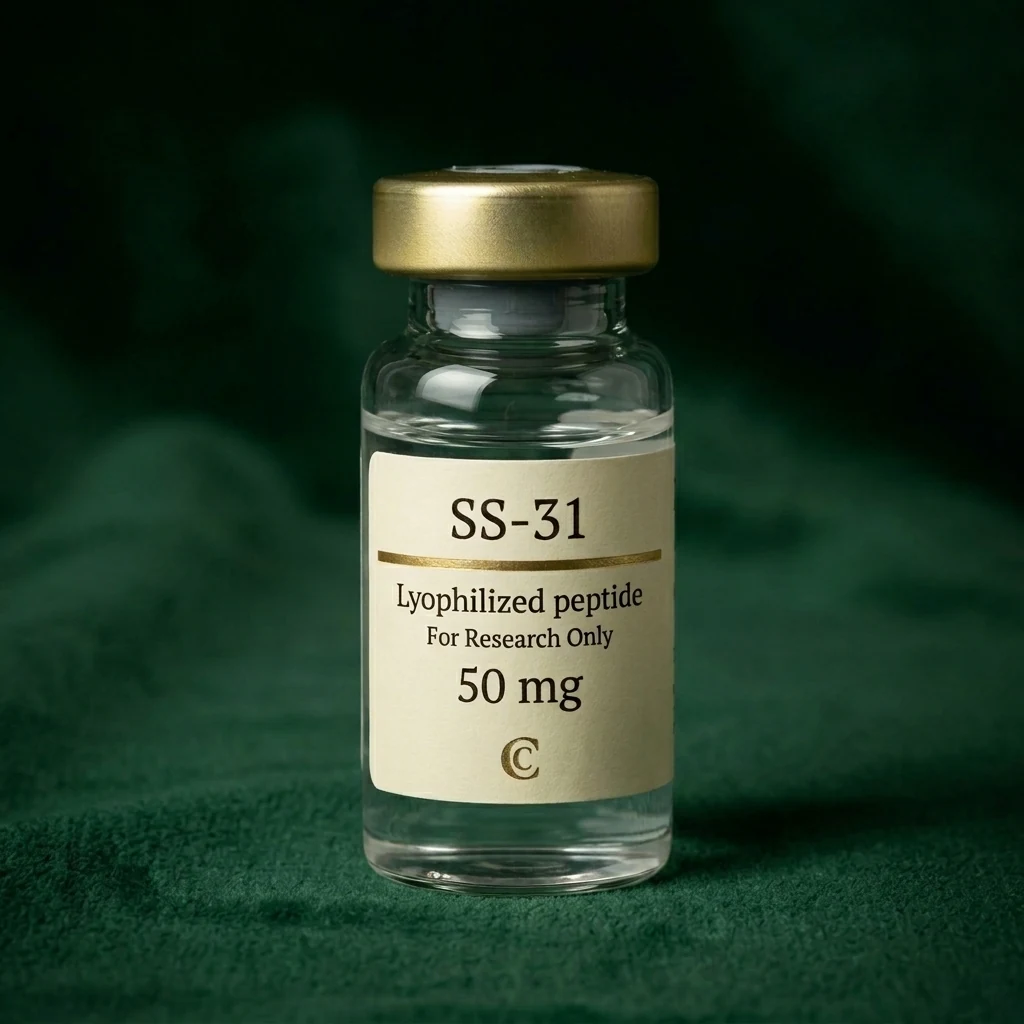
SS-31
50 mg freeze-dried vial, mitochondrial cardiolipin-targeting peptide
Compound specifications, chemistry, and storage.
Technical specifications
Specimen format| Compound name | SS-31 |
| Also known as | elamipretide, MTP-131, Bendavia, RX 31 |
| CAS number | 736992-21-5 |
| PubChem CID | 11765583 → |
| InChI Key | PMKHKYBXBZUJOB-YRTQKHEUSA-N |
| SMILES | Reference SMILES on COA |
| Empirical formula (Hill notation) | C32H49N9O5 |
| Molecular weight | 639.79 g/mol (monoisotopic mass: 639.39) |
| Salt form | Acetate (default) |
| Counter-ion content | Quantified per batch on COA. Custom salt forms (chloride, ammonium, TFA) available on quote. |
| Sequence (1-letter) | D-Arg-(2,6-dimethyl-Tyr)-Lys-Phe-NH2 |
| Sequence (3-letter) | D-Arg-Dmt-Lys-Phe amide; non-standard residues at positions 1 and 2 |
| Length | 4 amino acids (with non-standard residues) |
| Weight basis | Gross weight per industry standard. Net peptide content quantified on batch COA. |
| Quantity per vial | 50 mg |
| Format | Freeze-dried white powder or thin film, sealed under inert atmosphere. Why does the vial look empty? |
| Appearance | White freeze-dried cake or powder. May also appear as a thin film on the vial wall. |
| Solubility | Water soluble, reconstituted with bacteriostatic water (1 to 2 ml typical) |
| Solution colour | Clear and colourless when correctly reconstituted |
| Purity (HPLC) | Specification ≥98.5%, tested before listing |
| Identity confirmation | LC-MS, batch-specific spectrum on COA |
| Endotoxin (LAL) | Within Ph. Eur. specification, batch report on COA |
| Storage (freeze-dried) | 2 to 8 degrees Celsius, sealed, protected from light. Avoid thermal cycling. |
| Storage (reconstituted) | 2 to 8 degrees Celsius. Use within 4 to 6 weeks. Avoid repeated freeze-thaw. |
| Shelf life | 24 months from synthesis date when storage conditions are maintained |
| Country of synthesis | EU partner facility, Ph. Eur. methodology references |
| Application | In-vitro and preclinical research only. Not for human or veterinary use. |
Mitochondrial bioenergetics & cardiolipin biology
Primary research area. Studied for cardiolipin binding and inner-mitochondrial-membrane localisation.
Open research area → 02Oxidative stress & ageing biology
Secondary research area. Studied for mitochondrial dysfunction in age-related decline models.
Open research area →A mitochondrial-targeting tetrapeptide, and what the published research investigates.
SS-31, also known as elamipretide, is a synthetic four-amino-acid peptide that selectively localises to the inner mitochondrial membrane through interaction with cardiolipin, a lipid concentrated in mitochondrial membranes. The published research investigates mitochondrial bioenergetics, oxidative phosphorylation, cardiolipin remodelling in disease states, and the role of mitochondrial dysfunction in age-related decline. SS-31 has been investigated in human clinical trials by Stealth BioTherapeutics for several mitochondrial disease indications. The sections below summarise what the published research investigates, what Cresten supplies as the research-grade compound, and what the certificate of analysis confirms.
Where SS-31 comes from.
SS-31, also called elamipretide or by its earlier research code MTP-131, is a synthetic tetrapeptide developed from the Szeto-Schiller series, named for the two researchers who first described this class of cell-permeable, mitochondria-targeting peptides. Its sequence is D-Arg-dimethylTyr-Lys-Phe-NH2, an arrangement of alternating aromatic and basic residues with a structure designed to carry a net positive charge while crossing cell membranes. That combination is the whole point of the molecule: it is built to reach the inner mitochondrial membrane, which most peptides cannot.
The peptide is made by solid-phase synthesis, purified by reverse-phase HPLC, and freeze-dried. What ships is the lyophilized tetrapeptide, molecular weight near 640 g/mol, for reconstitution in a research setting. Because the molecule includes a D-amino acid and a dimethylated tyrosine, the synthesis and the identity confirmation matter more than usual; a batch certificate that confirms the exact mass is confirming a structure that ordinary peptides do not share.
What the research looks at.
The defining feature of SS-31 in the published research is that it binds cardiolipin, a phospholipid found almost exclusively in the inner mitochondrial membrane. Cardiolipin is involved in organising the electron transport chain, the machinery that produces most of a cell's energy. The research thesis, across animal and cell studies, is that by associating with cardiolipin SS-31 may influence mitochondrial membrane structure and the efficiency of that energy-producing machinery. That is the mechanism the literature returns to again and again.
From that starting point the published work spreads across tissues where mitochondrial function is energetically demanding: cardiac and skeletal muscle, kidney, and the nervous system. There have been animal studies in heart failure and ischaemia-reperfusion models, and SS-31, under the name elamipretide, has been examined in human clinical trials for mitochondrial disease and heart conditions, an unusually developed clinical record for a compound in this catalogue, though the trial results have been mixed and no broad approval has followed.
"The cardiolipin interaction is the consistent thread; what follows from it functionally is still being established across the literature."
Where the published research does not go: the human trials that exist have not produced a settled, approved therapeutic use, and a strong animal or mechanistic result is not a human outcome. The compound is supplied as a research compound. What it is studied for is in the literature, and we link what is indexed. We do not narrate an outcome for you.
What the certificate confirms.
Every Cresten batch of SS-31 ships with a certificate from an analytical lab, against the test panel described on the Methodology page. The certificate that ships with your batch confirms:
The certificate format is shown on the batch verification page.
Selected published research on SS-31.
Monograph last reviewed 26 May 2026 · references checked against PubMed
The curated reference list for SS-31 is being finalised against PubMed and will appear here. In the meantime, the indexed literature is available directly: PubMed results for SS-31.
What this monograph is not
This monograph summarises what the published research looks at regarding SS-31 mechanism. It is not a therapeutic recommendation. It is not dosing guidance. It is not a clinical protocol. It is not medical advice.
Cresten Labs supplies SS-31 as a research compound for lab-based research only. The decision to investigate any compound in any research framework is the researcher’s decision, within their own ethical, legal, and methodological boundaries.
Cresten makes no claim about human therapeutic use, no claim about clinical effectiveness, no claim about safety in human use, and no claim that this compound has been reviewed by any regulator for any medical use.
Frequently asked questions about SS-31
Common research-protocol and supply questions about SS-31, with answers grounded in published peer-reviewed research and Cresten Labs supply practice. All information is for in vitro and preclinical research only.
What is SS-31?
SS-31 is elamipretide, a 4-amino-acid peptide (CAS 736992-21-5, molecular weight 639.78 g/mol). Cresten Labs supplies SS-31 as a freeze-dried vial for in vitro and preclinical research only, with each batch verified at Janoshik Analytical.
What does research suggest SS-31 does?
Published research investigates SS-31 for targeting cardiolipin in the inner mitochondrial membrane and supporting mitochondrial-membrane integrity research. The compound is studied primarily in mitochondrial-membrane and ischemia-reperfusion research. SS-31 is supplied for research use only and is not approved by any regulator for medical use.
What is the typical SS-31 dosage in published research?
Published SS-31 dosage in research protocols ranges from 2 to 5 mg per administration, administered subcutaneously, with daily dosing in mitochondrial-pathway and ischemia-reperfusion research. Cresten Labs publishes the typical SS-31 protocol ranges as research-protocol references only; this is not dosing guidance for human use.
How do I reconstitute SS-31 for research?
Standard SS-31 reconstitution adds 1 mL of 0.9% NaCl bacteriostatic water for the 50 mg vial (NaCl strongly required). NaCl bacteriostatic water strongly required. SS-31 is highly cationic and reliably triggers welts with plain BAC water.
What is the SS-31 half-life and how is SS-31 storage handled?
Published research reports SS-31 systemic half-life at approximately 2 hours. SS-31 storage: lyophilized vial stable at room temperature for shipping; reconstituted solution stored at 2 to 8 °C and used within 1 to 2 weeks. The Cresten certificate of analysis lists the synthesis date, batch identifier, and the storage conditions verified for this specific batch.
What does the research literature report about SS-31 side effects?
Published SS-31 research reports the following: reliable injection-site welts reported with plain BAC water due to high cationicity; NaCl bacteriostatic water dampens this reaction. Cresten Labs supplies the compound for research use only; clinical-use side-effect data should be drawn from peer-reviewed clinical trial publications, not from research-vendor pages.
What is the typical SS-31 protocol duration in research?
Published SS-31 protocol research typically runs daily dosing in mitochondrial-pathway and ischemia-reperfusion research. The SS-31 protocol duration depends on the research question being studied. The Cresten reconstitution calculator includes a schedule planner that flags the 28-day refrigerated shelf-life of the reconstituted solution.
Where to buy SS-31 in Europe?
Cresten Labs supplies SS-31 across the EU single market to 16 European countries. Each SS-31 batch is tested at Janoshik Analytical with the certificate of analysis published on the website before it lists. SS-31 is sold for in vitro and preclinical research only, not for human or veterinary use.
How is SS-31 verified at Cresten Labs?
Every SS-31 batch is tested at Janoshik Analytical in Czech Republic, an third-party peptide-analysis laboratory. Each batch certificate documents HPLC purity, mass-spectrometry identity confirmation, and contamination panels. The certificate publishes with the batch, before it lists.
Is SS-31 legal to import for research in the EU?
Research-use peptides supplied with proper documentation are legally importable into EU member states for in vitro and preclinical research. Cresten ships SS-31 from inside the EU single market, so no customs declaration is required for shipments within EU member states. Local research-use regulations apply.