This compound is supplied for in-vitro and preclinical research only. It is not a medicinal product. It is not approved for human or veterinary use in any jurisdiction. No therapeutic, medicinal, cosmetic, or performance-enhancement claims are made or implied. By proceeding to inquire, you confirm you are an adult researcher acquiring this compound within your own research framework. Full terms on the Research Use Only page.
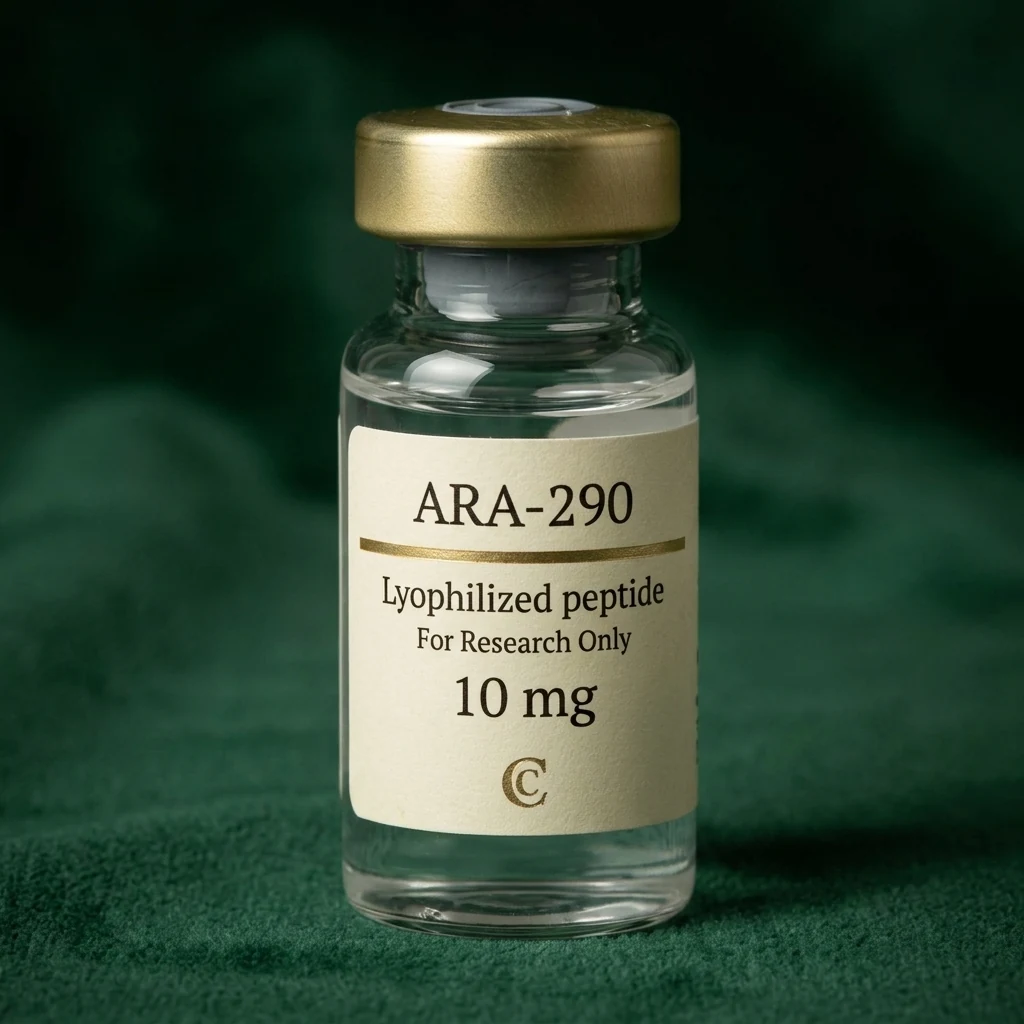
ARA-290
10 mg freeze-dried vial, erythropoietin-derived peptide
Compound specifications, chemistry, and storage.
Technical specifications
Specimen format| Compound name | ARA-290 (Cibinetide) |
| Also known as | Cibinetide, pyroglutamate helix B surface peptide, ARA290 |
| CAS number | 1208243-50-8 |
| PubChem CID | 71588037 → |
| InChI Key | Reference InChI Key on COA |
| SMILES | Reference SMILES on COA |
| Empirical formula (Hill notation) | C55H89N17O22 |
| Molecular weight | 1340.39 g/mol (monoisotopic mass: 1339.64) |
| Salt form | Acetate (default) |
| Counter-ion content | Quantified per batch on COA. Custom salt forms (chloride, ammonium, TFA) available on quote. |
| Sequence (1-letter) | QEQLERALNSS |
| Sequence (3-letter) | Gln-Glu-Gln-Leu-Glu-Arg-Ala-Leu-Asn-Ser-Ser |
| Length | 11 amino acids (EPO helix B fragment) |
| Weight basis | Gross weight per industry standard. Net peptide content quantified on batch COA. |
| Quantity per vial | 10 mg |
| Format | Freeze-dried white powder or thin film, sealed under inert atmosphere. Why does the vial look empty? |
| Appearance | White freeze-dried cake or powder. May also appear as a thin film on the vial wall. |
| Solubility | Water soluble, reconstituted with bacteriostatic water (1 to 2 ml typical) |
| Solution colour | Clear and colourless when correctly reconstituted |
| Purity (HPLC) | Specification ≥98.5%, tested before listing |
| Identity confirmation | LC-MS, batch-specific spectrum on COA |
| Endotoxin (LAL) | Within Ph. Eur. specification, batch report on COA |
| Storage (freeze-dried) | 2 to 8 degrees Celsius, sealed, protected from light. Avoid thermal cycling. |
| Storage (reconstituted) | 2 to 8 degrees Celsius. Use within 4 to 6 weeks. Avoid repeated freeze-thaw. |
| Shelf life | 24 months from synthesis date when storage conditions are maintained |
| Country of synthesis | EU partner facility, Ph. Eur. methodology references |
| Application | In-vitro and preclinical research only. Not for human or veterinary use. |
Anti-inflammatory & cytokine modulation
Primary research area. Studied for innate repair receptor signalling and inflammatory pathway modulation.
Open research area → 02Wound healing & tissue regeneration
Secondary research area. Studied in animal and clinical models of tissue protection and neuropathy.
Open research area →An erythropoietin-derived peptide, and what the published research says about it.
ARA-290, also called cibinetide, is a synthetic 11-amino-acid peptide derived from helix B of the erythropoietin (EPO) protein. The peptide retains the tissue-protective activity of EPO at the innate repair receptor (IRR) without the haematopoietic activity of the parent protein at the EPO receptor. Published research investigates the peptide in animal and clinical models of neuropathy and tissue protection. The sections below summarise what the published research investigates, what Cresten supplies, and what the certificate of analysis confirms.
Where ARA-290 comes from.
ARA-290, also called cibinetide, is a synthetic 11-amino-acid peptide derived from the helix B region of the erythropoietin (EPO) protein. The native EPO protein is 165 amino acids long and is the principal regulator of red blood cell production through its action at the EPO receptor on bone-marrow erythroid progenitor cells. The published research that led to the development of ARA-290 identified that the tissue-protective effects of EPO observed in non-haematopoietic tissues operate through a different receptor (the innate repair receptor, IRR) than the canonical EPO receptor responsible for haematopoiesis.
The peptide was developed in the 2000s by a research group at the Feinstein Institute of Medical Research and at Araim Pharmaceuticals to dissociate the tissue-protective IRR-mediated activity of EPO from its haematopoietic receptor activity. The 11-residue helix B fragment retains binding to the IRR but does not engage the canonical EPO receptor, producing a research compound that probes the IRR pathway selectively. The peptide is built by Fmoc solid-phase peptide synthesis, purified by reversed-phase HPLC, and freeze-dried.
PubMed lists roughly 60 papers mentioning ARA-290 or cibinetide as of 2026. The published research is concentrated in animal models of neuropathy and tissue protection, with a smaller body of clinical work in neuropathic-pain research. The compound has been the subject of phase-two clinical investigation; the research-supply form is identical in sequence to the investigational pharmaceutical product but is supplied for laboratory research only.
What the research looks at.
ARA-290 mechanism research starts from the innate repair receptor (IRR), a heteromeric receptor complex composed of the EPO receptor and the common beta receptor (CD131). The IRR is expressed on non-haematopoietic tissues including neurons, vascular endothelium, and immune cells. Published cell-culture studies have characterised ARA-290 binding and signalling at the IRR, distinguishing it from the canonical EPO receptor that mediates haematopoiesis.
A second strand of research has examined the peptide in animal models of neuropathy. Published studies in chemotherapy-induced peripheral neuropathy and diabetic neuropathy models measure neurological endpoints, electrophysiological markers, and tissue-level inflammatory and apoptotic markers. The literature describes the peptide as producing tissue-protective effects through the IRR pathway, with the absence of haematopoietic activity confirmed by haematocrit measurements in the same animal designs.
"The dissociation of tissue-protective activity from haematopoietic activity is the defining feature of ARA-290 in the published research and is the reason for its development as a research tool."
A third line of research has examined the peptide in inflammatory-pathway contexts. Published cell-culture and animal studies measure inflammatory-cytokine production, immune-cell infiltration, and tissue-injury markers in inflammatory-disease model systems. The literature describes the IRR pathway as producing anti-inflammatory and tissue-protective effects through mechanisms distinct from the broader anti-inflammatory pharmacology of corticosteroids or NSAIDs.
Where the published research does not go in the research-supply context: laboratory research does not extend to administration to humans, off-label clinical use, or any therapeutic application. ARA-290 has been the subject of phase-two clinical investigation but has not advanced to product approval. The research-supply form is supplied for laboratory research only.
What the certificate confirms.
Every Cresten batch of BPC-157 ships with a certificate from an analytical lab, against the test panel described on the Methodology page. The certificate that ships with your batch confirms:
The certificate format is shown on the batch verification page.
Selected published research on ARA-290.
Monograph last reviewed 26 May 2026 · references checked against PubMed
The curated reference list for ARA-290 is being finalised against PubMed and will appear here. In the meantime, the indexed literature is available directly: PubMed results for ARA-290.
What this monograph is not
This monograph summarises what the published research looks at regarding BPC-157 mechanism. It is not a therapeutic recommendation. It is not dosing guidance. It is not a clinical protocol. It is not medical advice.
Cresten Labs supplies BPC-157 as a research compound for lab-based research only. The decision to investigate any compound in any research framework is the researcher’s decision, within their own ethical, legal, and methodological boundaries.
Cresten makes no claim about human therapeutic use, no claim about clinical effectiveness, no claim about safety in human use, and no claim that this compound has been reviewed by any regulator for any medical use.
Frequently asked questions about ARA-290
Common research-protocol and supply questions about ARA-290, with answers grounded in published peer-reviewed research and Cresten Labs supply practice. All information is for in vitro and preclinical research only.
What is ARA-290?
ARA-290 is cibinetide, a 11-amino-acid peptide (CAS 1208243-50-8, molecular weight 1257.43 g/mol). Cresten Labs supplies ARA-290 as a freeze-dried vial for in vitro and preclinical research only, with each batch verified at Janoshik Analytical.
What does research suggest ARA-290 does?
Published research investigates ARA-290 for erythropoietin-derived peptide modulating innate-immune-receptor signaling in inflammation and neuropathy research. The compound is studied primarily in neuropathy and innate-immune-pathway research. ARA-290 is supplied for research use only and is not approved by any regulator for medical use.
What is the typical ARA-290 dosage in published research?
Published ARA-290 dosage in research protocols ranges from 0.5 to 4 mg per administration, administered subcutaneously, with daily dosing in neuropathy and innate-immune research. Cresten Labs publishes the typical ARA-290 protocol ranges as research-protocol references only; this is not dosing guidance for human use.
How do I reconstitute ARA-290 for research?
Standard ARA-290 reconstitution adds 2 mL bacteriostatic water (NaCl preferred) for the 10 mg vial. NaCl bacteriostatic water preferred for the cationic peptide class.
What is the ARA-290 half-life and how is ARA-290 storage handled?
Published research reports ARA-290 systemic half-life at approximately 2 hours. ARA-290 storage: lyophilized vial stable at room temperature for shipping; reconstituted solution stored at 2 to 8 °C and used within 28 days. The Cresten certificate of analysis lists the synthesis date, batch identifier, and the storage conditions verified for this specific batch.
What does the research literature report about ARA-290 side effects?
Published ARA-290 research reports the following: preclinical and early-clinical research reports tolerability; the cationic structure benefits from NaCl bacteriostatic water. Cresten Labs supplies the compound for research use only; clinical-use side-effect data should be drawn from peer-reviewed clinical trial publications, not from research-vendor pages.
What is the typical ARA-290 protocol duration in research?
Published ARA-290 protocol research typically runs daily dosing in neuropathy and innate-immune research. The ARA-290 protocol duration depends on the research question being studied. The Cresten reconstitution calculator includes a schedule planner that flags the 28-day refrigerated shelf-life of the reconstituted solution.
Where to buy ARA-290 in Europe?
Cresten Labs supplies ARA-290 across the EU single market to 16 European countries. Each ARA-290 batch is tested at Janoshik Analytical with the certificate of analysis published on the website before it lists. ARA-290 is sold for in vitro and preclinical research only, not for human or veterinary use.
How is ARA-290 verified at Cresten Labs?
Every ARA-290 batch is tested at Janoshik Analytical in Czech Republic, an third-party peptide-analysis laboratory. Each batch certificate documents HPLC purity, mass-spectrometry identity confirmation, and contamination panels. The certificate publishes with the batch, before it lists.
Is ARA-290 legal to import for research in the EU?
Research-use peptides supplied with proper documentation are legally importable into EU member states for in vitro and preclinical research. Cresten ships ARA-290 from inside the EU single market, so no customs declaration is required for shipments within EU member states. Local research-use regulations apply.