This compound is supplied for in-vitro and preclinical research only. It is not a medicinal product. It is not approved for human or veterinary use in any jurisdiction. No therapeutic, medicinal, cosmetic, or performance-enhancement claims are made or implied. By proceeding to inquire, you confirm you are an adult researcher acquiring this compound within your own research framework. Full terms on the Research Use Only page.
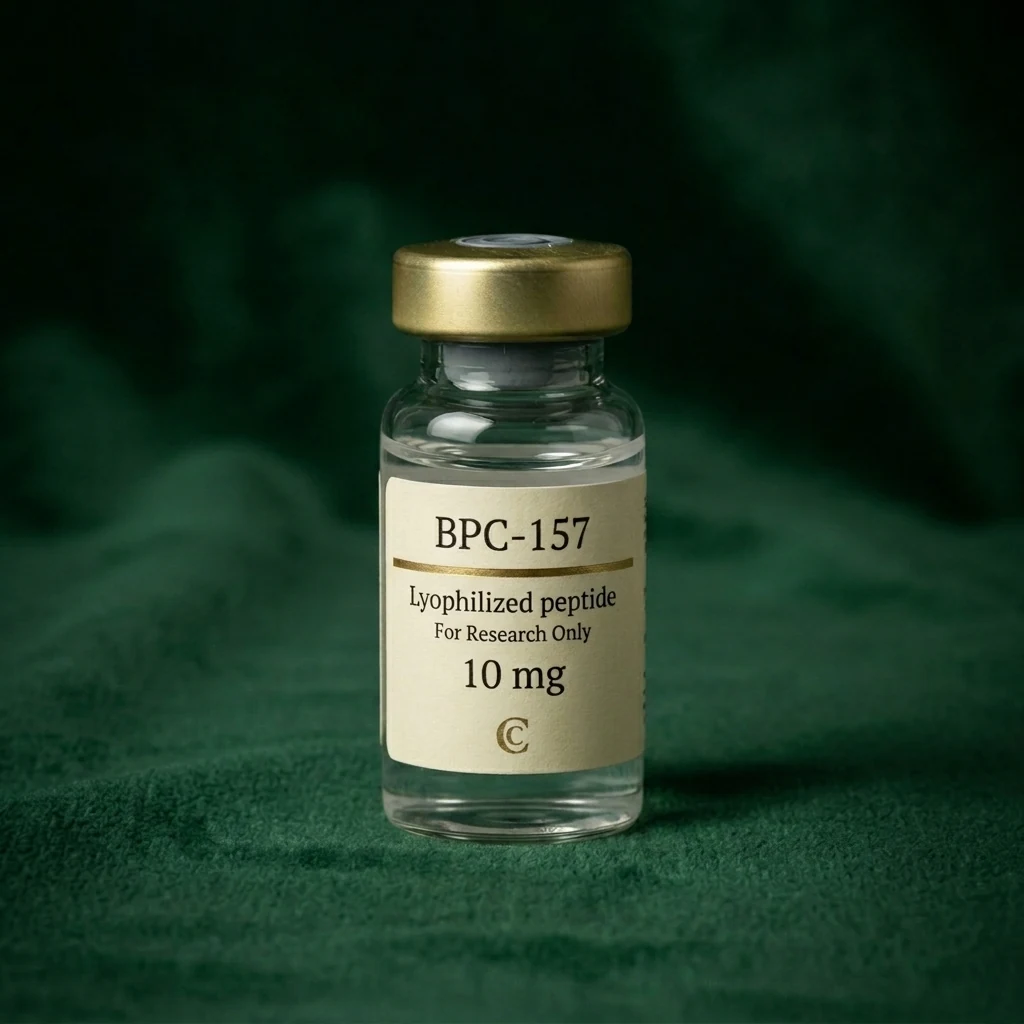
BPC-157
10 mg freeze-dried vial. Also written BPC 157 (space) or BPC157. Body Protection Compound 157
Compound specifications, chemistry, and storage.
Technical specifications
Specimen format| Compound name | BPC-157 (Body Protection Compound 157) |
| Also known as | BPC, Body Protection Compound, pentadecapeptide BPC-157, gastric pentadecapeptide, PL 14736, bepecin, Booly |
| CAS number | 137525-51-0 |
| PubChem CID | 9941957 → |
| InChI Key | RJEZTFGTVHHTAH-RABKVUJESA-N |
| SMILES | CC(C)C[C@H](NC(=O)CNC(=O)[C@H](C)NC(=O)[C@H](CC(O)=O)NC(=O)[C@H](CC(O)=O)NC(=O)[C@H](C)NC(=O)[C@@H]1CCCN1C(=O)[C@H](CCCCN)NC(=O)CNC(=O)[C@@H]1CCCN1C(=O)[C@@H]1CCCN1C(=O)[C@@H]1CCCN1C(=O)[C@H](CCC(O)=O)NC(=O)CN)C(=O)O |
| Empirical formula (Hill notation) | C₆₂H₉₈N₁₆O₂₂ |
| Molecular weight | 1419.55 g/mol (monoisotopic mass: 1418.67) |
| Salt form | Acetate (default) |
| Counter-ion content | Quantified per batch on COA. Custom salt forms (chloride, ammonium, TFA) available on quote. |
| Sequence (1-letter) | GEPPPGKPADDAGLV |
| Sequence (3-letter) | Gly-Glu-Pro-Pro-Pro-Gly-Lys-Pro-Ala-Asp-Asp-Ala-Gly-Leu-Val |
| Length | 15 amino acids (fifteen-amino-acid peptide) |
| Weight basis | Gross weight per industry standard. Net peptide content quantified on batch COA. |
| Quantity per vial | 10 mg |
| Format | Freeze-dried white powder or thin film, sealed under inert atmosphere. Why does the vial look empty? |
| Appearance | White freeze-dried cake or powder. May also appear as a thin film on the vial wall. |
| Solubility | Water soluble, reconstituted with bacteriostatic water (1 to 2 ml typical) |
| Solution colour | Clear and colourless when correctly reconstituted |
| Purity (HPLC) | Specification ≥99.0%, tested before listing |
| Identity confirmation | LC-MS, batch-specific spectrum on COA |
| Endotoxin (LAL) | Within Ph. Eur. specification, batch report on COA |
| Storage (freeze-dried) | 2 to 8 degrees Celsius, sealed, protected from light. Avoid thermal cycling. |
| Storage (reconstituted) | 2 to 8 degrees Celsius. Use within 4 to 6 weeks. Avoid repeated freeze-thaw. |
| Shelf life | 24 months from synthesis date when storage conditions are maintained |
| Country of synthesis | EU partner facility, Ph. Eur. methodology references |
| Application | In-vitro and preclinical research only. Not for human or veterinary use. |
Wound healing & tissue regeneration
Most-cited compound in this area. Studied for fibroblast migration, angiogenesis, and gastrointestinal mucosal protection.
Open research area → 02Anti-inflammatory & cytokine modulation
Secondary research area. Studied for anti-inflammatory mechanisms in gastrointestinal mucosa and chemical-injury models.
Open research area →A fifteen-amino-acid peptide, and what the published research says about it.
BPC 157 is a synthetic fifteen-amino-acid peptide, and it is the most-requested compound we supply. It came out of an unlikely place: a protein the body keeps in its own stomach lining. Three decades of published work have followed it since, almost all of it in animal and laboratory models. What follows is the part we can stand behind, what the compound is, where it came from, what the literature actually examines, and what the certificate confirms. What it does in a body is not ours to tell you. That belongs to the research, and we link the research.
Where BPC-157 comes from.
Here is the part most buyers do not know. BPC 157 is not a designed molecule. It is a fragment of something the human body already makes. In the early 1990s, researchers isolated a protective protein from human gastric juice, the fluid the stomach uses to defend its own lining against the acid it produces. That protein is called body protection compound. BPC 157 is the fifteen-amino-acid stretch of it that carried the activity the original group was chasing. The 157 is not a batch code or a catalogue number. It is the position of those residues in the parent sequence. So when you reconstitute a vial, you are working with a copy of a fragment the body evolved to protect itself. That origin is most of why the research community kept looking.
The version in the vial is made the way every serious research peptide is made: built one amino acid at a time on a solid support by Fmoc solid-phase synthesis, then purified by HPLC until the main peak is clean. After that it is freeze-dried and sealed under inert atmosphere, which is why it arrives as the thin film described above and stays stable at room temperature in transit. It only wants cold once you have reconstituted it. Bacteriostatic water at the bench, and it goes into solution clear and colourless if it is what it should be. If it does not, that tells you something too.
The literature is unusually deep for a compound this size. PubMed carries more than 180 papers naming BPC 157 as of 2026, the large majority animal and in-vitro work, with a small number of early human studies. That depth is why it sits at the front of our catalogue and why the SERPs for it are full of vendors who never tested a batch. We took the opposite approach, and we compare ourselves against them openly. The research is real and you can read it; the verification is the part most vendors skip, and that is the part we built the company around. There is a second reason BPC 157 specifically attracts bad supply. It is the compound newcomers reach for first, which means it is the one most often sold by operators who count on buyers not knowing how to check. A clean-looking vial and a generic PDF are enough to close an inexperienced researcher. They are not enough to close anyone who has read this far. The fifteen-residue identity is verifiable by mass, the purity is verifiable by HPLC, and the batch is traceable to the lab that ran both. With BPC 157 more than almost any other compound, the question is not whether you can find it. It is whether you can trust the vial in your hand, and that is a question with a documented answer here.
What the research looks at.
The research on how BPC 157 works covers several pathways. Studies have looked at how the peptide affects new blood vessel formation, including its interaction with a receptor called VEGFR2 in animal studies of small blood vessel response. Other studies have looked at the peptide's role in nitric oxide pathways, including effects on an enzyme called eNOS in animal studies of blood vessel function.
Research has also looked at fibroblast and tendon biology in cell culture and animal studies. Papers have examined fibroblast movement and collagen organisation, with work in animal models of tendon injury. The research is consistent in describing the peptide as a signal that triggers other steps, rather than something that acts directly on cells. The exact receptor interactions are still not fully mapped in the published research.
"The peptide's exact receptor interactions are still not fully mapped in the published research."
Research on the gut and stomach is the largest single category of BPC 157 work. Since the compound was first found in stomach fluid, a large body of animal research looks at stomach lining protection, ulcer healing rates, and small blood vessels in the gut. The research in this area is the most developed and the most cited.
Where the published research does not go: there are no large randomised controlled trials in humans. There are no FDA or EMA approvals for any medical use. The compound is classified as a research compound, and research is the only context in which it is supplied.
What the certificate confirms.
Every Cresten batch of BPC 157 ships with a certificate from an analytical lab, against the test panel described on the Methodology page. The certificate that ships with your batch confirms:
The certificate format is shown on the batch verification page.
Selected published research on BPC-157.
Monograph last reviewed 26 May 2026 · references checked against PubMed
The references below are a small selection from the wider published research. Each one can be checked on PubMed using the PMID number listed.
Citation note: each PMID resolves to PubMed at ncbi.nlm.nih.gov/pubmed/{PMID}. The references above are a small selection from the wider published research.
What this monograph is not
This monograph summarises what the published research looks at regarding BPC 157 mechanism. It is not a therapeutic recommendation. It is not dosing guidance. It is not a clinical protocol. It is not medical advice.
Cresten Labs supplies BPC 157 as a research compound for lab-based research only. The decision to investigate any compound in any research framework is the researcher’s decision, within their own ethical, legal, and methodological boundaries.
Cresten makes no claim about human therapeutic use, no claim about clinical effectiveness, no claim about safety in human use, and no claim that this compound has been reviewed by any regulator for any medical use.
Frequently asked questions about BPC-157
Common research-protocol and supply questions about BPC 157, with answers grounded in published peer-reviewed research and Cresten Labs supply practice. All information is for in vitro and preclinical research only.
What is BPC-157?
BPC 157 is Body Protection Compound 157, a 15-amino-acid peptide (CAS 137525-51-0, molecular weight 1419.556 g/mol). Cresten Labs supplies BPC 157 as a freeze-dried vial for in vitro and preclinical research only, with each batch verified at Janoshik Analytical.
What does research suggest BPC-157 does?
Published research investigates BPC 157 for directing endothelial cell migration and capillary sprouting toward damaged tissue in preclinical models. The compound is studied primarily in soft tissue and gastrointestinal mucosa research. BPC 157 is supplied for research use only and is not approved by any regulator for medical use.
What is the typical BPC-157 dosage in published research?
Published BPC 157 dosage in research protocols ranges from 100 to 500 mcg per administration, administered subcutaneously, with daily dosing for 4 to 6 weeks in tendon and gut repair studies. Cresten Labs publishes the typical BPC 157 protocol ranges as research-protocol references only; this is not dosing guidance for human use.
How do I reconstitute BPC-157 for research?
Standard BPC 157 reconstitution adds 2 mL plain bacteriostatic water for the 10 mg vial. Cresten ships lyophilized BPC-157 vials for reconstitution by the researcher per their protocol.
What is the BPC-157 half-life and how is BPC-157 storage handled?
Published research reports BPC 157 systemic half-life at approximately 4 hours systemic. BPC 157 storage: lyophilized vial stable at room temperature for shipping; reconstituted solution stored at 2 to 8 °C and used within 28 days. The Cresten certificate of analysis lists the synthesis date, batch identifier, and the storage conditions verified for this specific batch.
BPC-157 vs TB-500: how do they compare in research?
In published research comparing BPC 157 vs TB-500, BPC 157 acts on capillary growth, TB-500 on actin polymerization; the two operate on complementary repair pathways in the published preclinical literature. The two compounds are studied separately and in combination depending on the research question. Cresten Labs supplies both as verified research compounds.
What does research literature report about BPC-157 side effects?
Published BPC 157 research reports the following: preclinical studies report a benign side-effect profile in animal models; human safety data is limited because no regulator has approved BPC 157 for medical use anywhere. Cresten Labs supplies the compound for research use only; clinical-use side-effect data should be drawn from peer-reviewed clinical trial publications, not from research-vendor pages.
Where to buy BPC-157 in Europe?
Cresten Labs supplies BPC 157 across the EU single market to 16 European countries. Each BPC 157 batch is tested at Janoshik Analytical with the certificate of analysis published on the website before it lists. BPC-157 is sold for in vitro and preclinical research only, not for human or veterinary use.
How is BPC-157 verified at Cresten Labs?
Every BPC 157 batch is tested at Janoshik Analytical in Czech Republic, an third-party peptide-analysis laboratory. Each batch certificate documents HPLC purity, mass-spectrometry identity confirmation, and contamination panels. The certificate publishes with the batch, before it lists.
What is the typical BPC-157 stack in published research?
In published research, the typical BPC 157 stack pairs the compound with TB-500. BPC 157 acts on capillary growth, TB-500 on actin polymerization; the two operate on complementary repair pathways in the published preclinical literature.