This compound is supplied for in-vitro and preclinical research only. It is not a medicinal product. It is not approved for human or veterinary use in any jurisdiction. No therapeutic, medicinal, cosmetic, or performance-enhancement claims are made or implied. By proceeding to inquire, you confirm you are an adult researcher acquiring this compound within your own research framework. Full terms on the Research Use Only page.
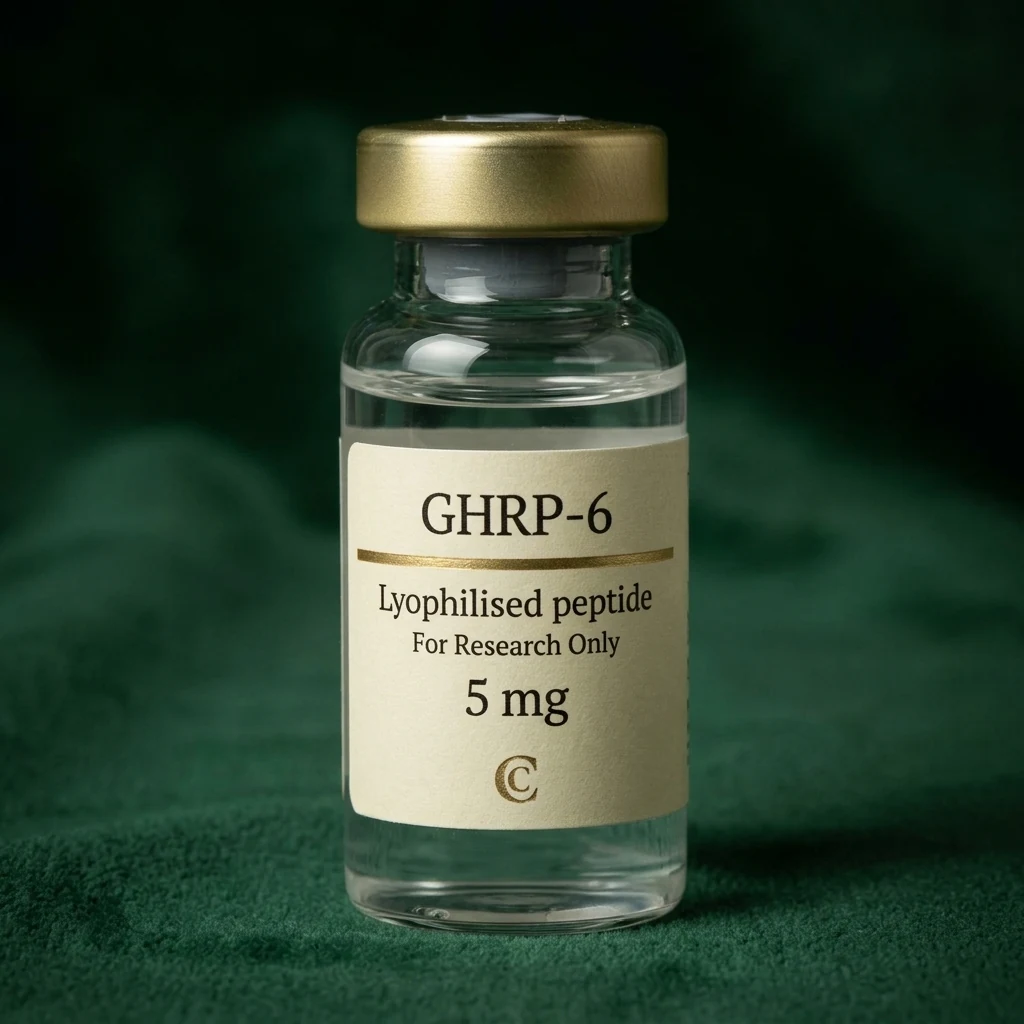
GHRP-6
5 mg freeze-dried vial, hexapeptide GHRP-class compound
Compound specifications, chemistry, and storage.
Technical specifications
Specimen format| Compound name | GHRP-6 (Growth Hormone Releasing Peptide 6) |
| Also known as | GHRP6, growth hormone releasing peptide 6, growth hormone secretagogue |
| CAS number | 87616-84-0 |
| PubChem CID | 11507549 → |
| InChI Key | Reference InChI Key on COA |
| SMILES | Reference SMILES on COA |
| Empirical formula (Hill notation) | C46H56N12O6 |
| Molecular weight | 873.01 g/mol (monoisotopic mass: 872.43) |
| Salt form | Acetate (default) |
| Counter-ion content | Quantified per batch on COA. Custom salt forms (chloride, ammonium, TFA) available on quote. |
| Sequence (1-letter) | His-D-Trp-Ala-Trp-D-Phe-Lys-NH2 |
| Sequence (3-letter) | L-Histidyl-D-tryptophyl-L-alanyl-L-tryptophyl-D-phenylalanyl-L-lysinamide |
| Length | 6 amino acids (hexapeptide) with two D-amino-acid substitutions |
| Weight basis | Gross weight per industry standard. Net peptide content quantified on batch COA. |
| Quantity per vial | 5 mg |
| Format | Freeze-dried white powder or thin film, sealed under inert atmosphere. Why does the vial look empty? |
| Appearance | White freeze-dried cake or powder. May also appear as a thin film on the vial wall. |
| Solubility | Water soluble, reconstituted with bacteriostatic water (1 to 2 ml typical) |
| Solution colour | Clear and colourless when correctly reconstituted |
| Purity (HPLC) | Specification ≥98.5%, tested before listing |
| Identity confirmation | LC-MS, batch-specific spectrum on COA |
| Endotoxin (LAL) | Within Ph. Eur. specification, batch report on COA |
| Storage (freeze-dried) | 2 to 8 degrees Celsius, sealed, protected from light. Avoid thermal cycling. |
| Storage (reconstituted) | 2 to 8 degrees Celsius. Use within 4 to 6 weeks. Avoid repeated freeze-thaw. |
| Shelf life | 24 months from synthesis date when storage conditions are maintained |
| Country of synthesis | EU partner facility, Ph. Eur. methodology references |
| Application | In-vitro and preclinical research only. Not for human or veterinary use. |
Growth hormone secretagogue pathways
Primary research area. Studied as a foundational GHSR1a reference compound in ghrelin-receptor pharmacology research.
Open research area → 02Mitochondrial & longevity research
Secondary research area. Studied for appetite-regulation pathway research and downstream metabolic effects.
Open research area →A GHRP-class hexapeptide, and what the published research says about it.
GHRP-6 is a synthetic six-amino-acid peptide that, alongside GHRP-2, was one of the first synthetic ghrelin-mimetic compounds described in the published literature. The peptide acts at the growth-hormone secretagogue receptor (GHSR1a) and produces strong growth-hormone release in animal models, with notable concomitant activation of appetite-regulation pathways and prolactin secretion. Published research uses GHRP-6 extensively as a reference compound for ghrelin-receptor pharmacology. The sections below summarise what the published research investigates, what Cresten supplies, and what the certificate of analysis confirms.
Where GHRP-6 comes from.
GHRP-6 is a synthetic six-amino-acid peptide first described in the published literature in 1984 by Cyril Bowers and colleagues at Tulane University, the same research group that later described GHRP-2. GHRP-6 is the foundational compound in the growth-hormone-releasing peptide (GHRP) class: the original published work establishing that synthetic peptides could release growth hormone through a pathway distinct from the GHRH receptor used GHRP-6 as the principal experimental tool. The compound predates the identification of the receptor on which it acts, which was later characterised in the 1990s and given the name growth-hormone secretagogue receptor (GHSR1a).
The peptide is built by Fmoc solid-phase peptide synthesis with two D-amino-acid substitutions (positions 2 and 5) that improve resistance to proteolytic degradation. After purification by reversed-phase HPLC the peptide is freeze-dried and sealed in vials. The freeze-dried form is stable at room temperature. The published literature uses GHRP-6 and growth-hormone-releasing peptide-6 interchangeably; the compound has no widely used trade name in research contexts.
PubMed lists more than 600 papers mentioning GHRP-6 as of 2026, more than any other single compound in the GHRP class. The published literature spans the original receptor-identification work of the 1980s and 1990s, animal pharmacology studies, ghrelin-receptor structural biology research, and a smaller body of human pilot studies. GHRP-6 is the compound most cited as the historical reference in the GHRP-class literature; later compounds in the class (GHRP-2, Hexarelin, Ipamorelin) are typically introduced in the published research with reference to GHRP-6.
What the research looks at.
GHRP-6 mechanism research established the foundational understanding of the growth-hormone secretagogue receptor (GHSR1a). Published structure-activity research in the 1990s used GHRP-6 as the principal tool to map the receptor binding pocket, and the compound was central to the work that culminated in the 1999 identification of the natural ligand ghrelin. Cell-culture binding studies measure GHRP-6 affinity at GHSR1a at potency lower than the later compound GHRP-2 but with substantial measurable activity.
A second strand of research has examined appetite-regulation pathways. GHSR1a receptors are expressed not only on anterior pituitary somatotrophs but also in hypothalamic regions involved in appetite regulation. Published animal studies measure the effects of GHRP-6 administration on neuronal activity in defined hypothalamic nuclei and on feeding-behaviour endpoints. The published literature describes the appetite-regulation effect as a notable pharmacological feature of GHRP-6 that is shared with the natural ghrelin ligand and is observed at lower intensity with selective GHSR1a-agonists such as Ipamorelin.
"GHRP-6 is the foundational research tool that established the growth-hormone-secretagogue receptor as a separate pharmacological target from the GHRH receptor."
A third line of research uses GHRP-6 in combination-research designs alongside GHRH-class compounds. Published animal studies report additive or synergistic effects on growth-hormone secretion when GHRP-6 is administered with native GHRH or with stabilised GHRH analogues, mirroring the combination-research designs used with GHRP-2. The literature describes these dual-receptor designs as producing pulsatile-secretion patterns that exceed single-receptor activation.
Where the published research does not go: there are no FDA or EMA approvals for GHRP-6 in any indication. Human pilot studies have been published but have not advanced to large randomised clinical trials. The compound is supplied as a research compound for laboratory research only.
What the certificate confirms.
Every Cresten batch of BPC-157 ships with a certificate from an analytical lab, against the test panel described on the Methodology page. The certificate that ships with your batch confirms:
The certificate format is shown on the batch verification page.
Selected published research on GHRP-6.
Monograph last reviewed 26 May 2026 · references checked against PubMed
The curated reference list for GHRP-6 is being finalised against PubMed and will appear here. In the meantime, the indexed literature is available directly: PubMed results for GHRP-6.
What this monograph is not
This monograph summarises what the published research looks at regarding BPC-157 mechanism. It is not a therapeutic recommendation. It is not dosing guidance. It is not a clinical protocol. It is not medical advice.
Cresten Labs supplies BPC-157 as a research compound for lab-based research only. The decision to investigate any compound in any research framework is the researcher’s decision, within their own ethical, legal, and methodological boundaries.
Cresten makes no claim about human therapeutic use, no claim about clinical effectiveness, no claim about safety in human use, and no claim that this compound has been reviewed by any regulator for any medical use.
Frequently asked questions about GHRP-6
Common research-protocol and supply questions about GHRP-6, with answers grounded in published peer-reviewed research and Cresten Labs supply practice. All information is for in vitro and preclinical research only.
What is GHRP-6?
GHRP-6 is growth-hormone-releasing peptide 6, a 6-amino-acid peptide (CAS 87616-84-0, molecular weight 872.44 g/mol). Cresten Labs supplies GHRP-6 as a freeze-dried vial for in vitro and preclinical research only, with each batch verified at Janoshik Analytical.
What does research suggest GHRP-6 does?
Published research investigates GHRP-6 for ghrelin receptor agonism stimulating growth-hormone release with appetite-modulating activity in research models. The compound is studied primarily in growth-hormone secretagogue and appetite-pathway research. GHRP-6 is supplied for research use only and is not approved by any regulator for medical use.
What is the typical GHRP-6 dosage in published research?
Published GHRP-6 dosage in research protocols ranges from 100 to 300 mcg per administration, administered subcutaneously, with two or three times daily in growth-hormone-release and appetite-pathway research. Cresten Labs publishes the typical GHRP-6 protocol ranges as research-protocol references only; this is not dosing guidance for human use.
How do I reconstitute GHRP-6 for research?
Standard GHRP-6 reconstitution adds 2 mL bacteriostatic water (NaCl preferred) for the 5 mg vial. NaCl bacteriostatic water preferred for the cationic peptide class.
What is the GHRP-6 half-life and how is GHRP-6 storage handled?
Published research reports GHRP-6 systemic half-life at approximately 60 minutes. GHRP-6 storage: lyophilized vial stable at room temperature for shipping; reconstituted solution stored at 2 to 8 °C and used within 28 days. The Cresten certificate of analysis lists the synthesis date, batch identifier, and the storage conditions verified for this specific batch.
GHRP-6 vs CJC-1295 No DAC: how do they compare in research?
In published research comparing GHRP-6 vs CJC-1295 No DAC, GHRP-6 acts on ghrelin receptors while CJC-1295 No DAC acts on GHRH receptors; the two pair on complementary growth-hormone pathways. The two compounds are studied separately and in combination depending on the research question. Cresten Labs supplies both as verified research compounds.
What does research literature report about GHRP-6 side effects?
Published GHRP-6 research reports the following: appetite-pathway activity reported in research; the cationic structure benefits from NaCl bacteriostatic water. Cresten Labs supplies the compound for research use only; clinical-use side-effect data should be drawn from peer-reviewed clinical trial publications, not from research-vendor pages.
Where to buy GHRP-6 in Europe?
Cresten Labs supplies GHRP-6 across the EU single market to 16 European countries. Each GHRP-6 batch is tested at Janoshik Analytical with the certificate of analysis published on the website before it lists. GHRP-6 is sold for in vitro and preclinical research only, not for human or veterinary use.
How is GHRP-6 verified at Cresten Labs?
Every GHRP-6 batch is tested at Janoshik Analytical in Czech Republic, an third-party peptide-analysis laboratory. Each batch certificate documents HPLC purity, mass-spectrometry identity confirmation, and contamination panels. The certificate publishes with the batch, before it lists.
What is the typical GHRP-6 stack in published research?
In published research, the typical GHRP-6 stack pairs the compound with CJC-1295 No DAC. GHRP-6 acts on ghrelin receptors while CJC-1295 No DAC acts on GHRH receptors; the two pair on complementary growth-hormone pathways.