This compound is supplied for in-vitro and preclinical research only. It is not a medicinal product. It is not approved for human or veterinary use in any jurisdiction. No therapeutic, medicinal, cosmetic, or performance-enhancement claims are made or implied. By proceeding to inquire, you confirm you are an adult researcher acquiring this compound within your own research framework. Full terms on the Research Use Only page.
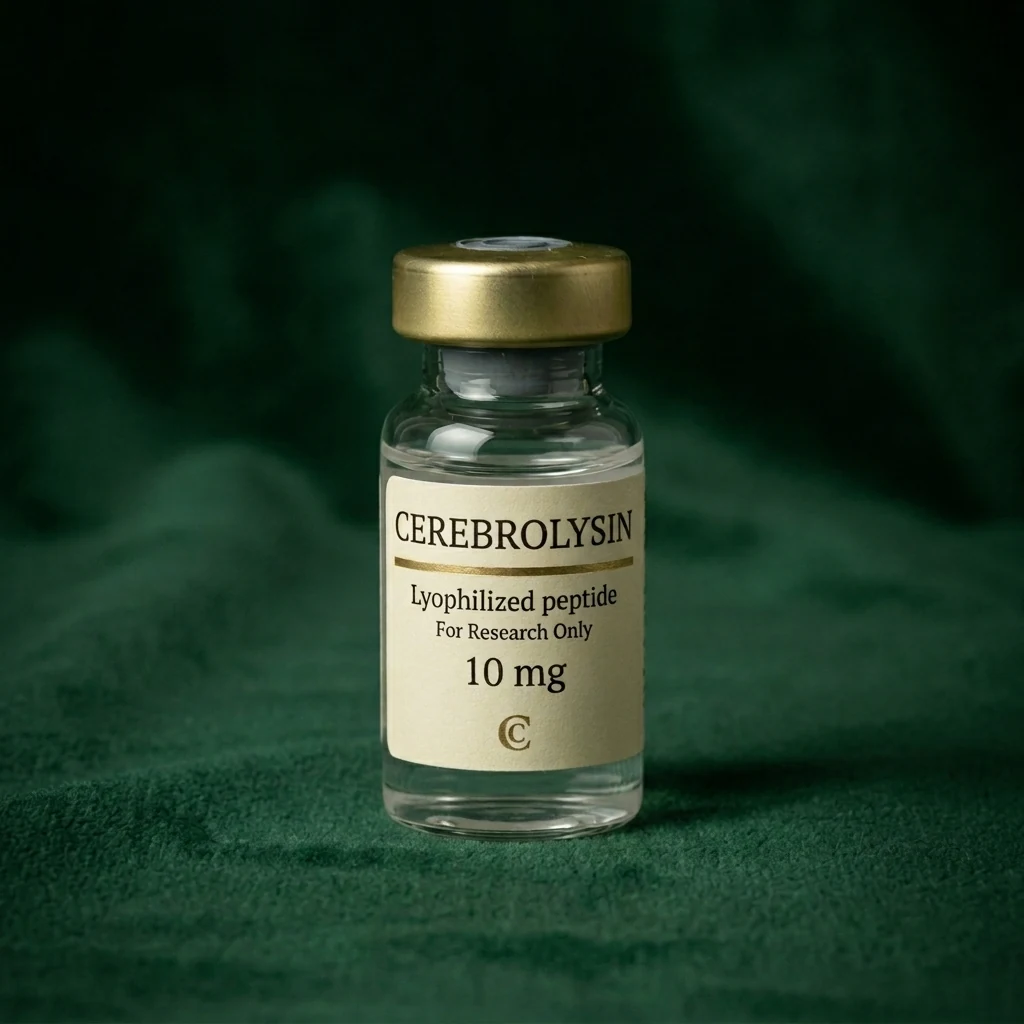
Cerebrolysin
215 mg freeze-dried vial, porcine brain peptide preparation
Compound specifications, chemistry, and storage.
Technical specifications
Specimen format| Compound name | Cerebrolysin |
| Also known as | FPF-1070, brain peptide preparation, neuropeptide preparation |
| CAS number | 12656-61-0 |
| PubChem CID | Reference CID on COA (mixed preparation) → |
| InChI Key | Mixed preparation, no single InChI Key |
| SMILES | Mixed peptide preparation |
| Empirical formula (Hill notation) | Mixed preparation, peptide fractions <10 kDa |
| Molecular weight | Mixed preparation, fractions <10,000 Da (monoisotopic mass: Mixed preparation, mass spectrum on COA) |
| Salt form | Lyophilised mixed preparation |
| Counter-ion content | Quantified per batch on COA. Custom salt forms (chloride, ammonium, TFA) available on quote. |
| Sequence (1-letter) | Mixed peptide preparation, no single sequence |
| Sequence (3-letter) | Standardised porcine brain peptide hydrolysate |
| Length | Mixed peptide fractions, molecular weight <10 kDa |
| Weight basis | Gross weight per industry standard. Net peptide content quantified on batch COA. |
| Quantity per vial | 215 mg |
| Format | Freeze-dried white powder or thin film, sealed under inert atmosphere. Why does the vial look empty? |
| Appearance | White freeze-dried cake or powder. May also appear as a thin film on the vial wall. |
| Solubility | Water soluble, reconstituted with bacteriostatic water (1 to 2 ml typical) |
| Solution colour | Clear and colourless when correctly reconstituted |
| Purity (HPLC) | Specification ≥98.5%, tested before listing |
| Identity confirmation | LC-MS, batch-specific spectrum on COA |
| Endotoxin (LAL) | Within Ph. Eur. specification, batch report on COA |
| Storage (freeze-dried) | 2 to 8 degrees Celsius, sealed, protected from light. Avoid thermal cycling. |
| Storage (reconstituted) | 2 to 8 degrees Celsius. Use within 4 to 6 weeks. Avoid repeated freeze-thaw. |
| Shelf life | 24 months from synthesis date when storage conditions are maintained |
| Country of synthesis | EU partner facility, Ph. Eur. methodology references |
| Application | In-vitro and preclinical research only. Not for human or veterinary use. |
Neuropeptide & cognition
Primary research area. Studied in animal and clinical neurodegenerative-disorder research and neurotrophic-factor pathways.
Open research area → 02Mitochondrial & longevity research
Secondary research area. Studied for downstream effects on cellular energy metabolism and ageing markers.
Open research area →A porcine brain peptide preparation, and what the published research says about it.
Cerebrolysin is a defined peptide preparation produced by enzymatic hydrolysis of porcine brain proteins, yielding a mixture of low-molecular-weight peptides and free amino acids. The composition is standardised by the manufacturer, with active fractions identified by molecular weight cutoff and protein-content specification. Published research investigates the preparation in animal and clinical neurodegenerative-disorder research, with reported activity at neurotrophic-factor pathways. The sections below summarise what the published research investigates, what Cresten supplies, and what the certificate of analysis confirms.
Where Cerebrolysin comes from.
Cerebrolysin is unusual in the research-peptide context because it is not a single-sequence synthetic compound but a defined preparation of low-molecular-weight peptides and free amino acids produced by enzymatic hydrolysis of porcine brain proteins. The preparation was developed in the 1970s by the Austrian pharmaceutical company Ever Neuro Pharma under the research designation FPF-1070. The hydrolysis process targets brain proteins from young pig tissue and generates a mixture of peptide fragments below 10 kDa in molecular weight, accompanied by free amino acids.
The composition is standardised by the manufacturer through a defined hydrolysis protocol and quality-control specifications that include the molecular-weight cutoff of peptide fractions, the protein content per volume, and the analytical fingerprint by mass spectrometry. Each batch of the preparation is tested against the reference specification. After production the preparation is freeze-dried for the lyophilised research-supply form. The standardisation is what distinguishes Cerebrolysin from undefined biological hydrolysates: the literature regards it as a defined research preparation rather than a generic protein digest.
PubMed lists more than 700 papers mentioning Cerebrolysin as of 2026, with the published research concentrated in neurodegenerative-disorder research, animal stroke models, dementia-research clinical trials, and cognitive-aging research. The pharmaceutical version of the preparation has been used in clinical practice in some European jurisdictions for several decades, and a substantial clinical-research literature has accumulated. Accredited replication of clinical findings outside the original European research groups has produced mixed results in the published literature.
What the research looks at.
Cerebrolysin mechanism research has concentrated on neurotrophic-factor-like pathways. The published literature describes the preparation as producing effects in cell-culture and animal models that resemble those of defined neurotrophic factors such as brain-derived neurotrophic factor (BDNF) and nerve growth factor (NGF), although the active components in the preparation responsible for these effects have not been fully identified. Cell-culture studies measure neuronal survival, dendritic outgrowth, and synaptic-marker expression as endpoints in research designs.
A second strand of research has examined the preparation in animal stroke models. Published studies administer Cerebrolysin in focal cerebral ischemia models and measure infarct volume, neurological-score endpoints, and markers of inflammatory and apoptotic pathways. The literature in this strand is more developed than the cell-culture mechanism literature, with multiple accredited research groups reporting effects in the direction of neuroprotection in defined model systems.
"The active components in the Cerebrolysin preparation responsible for its observed effects have not been fully identified after five decades of published research."
A third line of research is the clinical literature in dementia and post-stroke recovery contexts. Published clinical trials in defined patient populations measure cognitive endpoints, functional-recovery scores, and biomarkers of neuronal injury or repair. The clinical literature is substantial, but methodological quality varies across studies and the largest randomised trials have produced mixed or modest results in the published reports. Accredited replication remains an active issue.
Where the published research does not go in the research-supply context: laboratory research does not extend to administration to humans, off-label clinical use, or any therapeutic application. The pharmaceutical version of the preparation is regulated separately under the Cerebrolysin trade name in some European jurisdictions. The research-supply form is supplied for laboratory research only.
What the certificate confirms.
Every Cresten batch of BPC-157 ships with a certificate from an analytical lab, against the test panel described on the Methodology page. The certificate that ships with your batch confirms:
The certificate format is shown on the batch verification page.
Selected published research on Cerebrolysin.
Monograph last reviewed 26 May 2026 · references checked against PubMed
The curated reference list for Cerebrolysin is being finalised against PubMed and will appear here. In the meantime, the indexed literature is available directly: PubMed results for Cerebrolysin.
What this monograph is not
This monograph summarises what the published research looks at regarding BPC-157 mechanism. It is not a therapeutic recommendation. It is not dosing guidance. It is not a clinical protocol. It is not medical advice.
Cresten Labs supplies BPC-157 as a research compound for lab-based research only. The decision to investigate any compound in any research framework is the researcher’s decision, within their own ethical, legal, and methodological boundaries.
Cresten makes no claim about human therapeutic use, no claim about clinical effectiveness, no claim about safety in human use, and no claim that this compound has been reviewed by any regulator for any medical use.
Frequently asked questions about Cerebrolysin
Common research-protocol and supply questions about Cerebrolysin, with answers grounded in published peer-reviewed research and Cresten Labs supply practice. All information is for in vitro and preclinical research only.
What is Cerebrolysin?
Cerebrolysin is a porcine brain peptide preparation, a 0-amino-acid peptide (CAS 12656-47-2, molecular weight mixture (1-10 kDa average peptide fragments)). Cresten Labs supplies Cerebrolysin as a freeze-dried vial for in vitro and preclinical research only, with each batch verified at Janoshik Analytical.
What does research suggest Cerebrolysin does?
Published research investigates Cerebrolysin for a porcine brain-derived peptide preparation supporting neurotrophic-factor and neuronal-survival research. The compound is studied primarily in neurodegenerative pathway and stroke-recovery research. Cerebrolysin is supplied for research use only and is not approved by any regulator for medical use.
What is the typical Cerebrolysin dosage in published research?
Published Cerebrolysin dosage in research protocols ranges from 5 to 10 mL of pre-formulated solution per administration in research, administered intramuscularly or intravenously, with daily dosing for 10 to 20 day cycles in neurodegenerative-pathway research. Cresten Labs publishes the typical Cerebrolysin protocol ranges as research-protocol references only; this is not dosing guidance for human use.
How is Cerebrolysin prepared for research use?
pre-formulated solution; reconstitution typically not required. Cerebrolysin ships as a pre-formulated solution, not as lyophilized powder; reconstitution is typically not required. Use within the shelf-life window noted on the COA. Storage and handling per published research protocols.
What is the Cerebrolysin half-life and how is Cerebrolysin storage handled?
Published research reports Cerebrolysin systemic half-life at variable across the peptide mixture. Cerebrolysin storage: pre-formulated solution stored at 2 to 8 °C; protect from light. The Cresten certificate of analysis lists the synthesis date, batch identifier, and the storage conditions verified for this specific batch.
What does the research literature report about Cerebrolysin side effects?
Published Cerebrolysin research reports the following: preclinical and clinical research reports a known tolerability profile; the compound is registered for medical use in some jurisdictions. Cresten Labs supplies the compound for research use only; clinical-use side-effect data should be drawn from peer-reviewed clinical trial publications, not from research-vendor pages.
What is the typical Cerebrolysin protocol duration in research?
Published Cerebrolysin protocol research typically runs daily dosing for 10 to 20 day cycles in neurodegenerative-pathway research. The Cerebrolysin protocol duration depends on the research question being studied. The Cresten reconstitution calculator includes a schedule planner that flags the 28-day refrigerated shelf-life of the reconstituted solution.
Where to buy Cerebrolysin in Europe?
Cresten Labs supplies Cerebrolysin across the EU single market to 16 European countries. Each Cerebrolysin batch is tested at Janoshik Analytical with the certificate of analysis published on the website before it lists. Cerebrolysin is sold for in vitro and preclinical research only, not for human or veterinary use.
How is Cerebrolysin verified at Cresten Labs?
Every Cerebrolysin batch is tested at Janoshik Analytical in Czech Republic, an third-party peptide-analysis laboratory. Each batch certificate documents HPLC purity, mass-spectrometry identity confirmation, and contamination panels. The certificate publishes with the batch, before it lists.
Is Cerebrolysin legal to import for research in the EU?
Research-use peptides supplied with proper documentation are legally importable into EU member states for in vitro and preclinical research. Cresten ships Cerebrolysin from inside the EU single market, so no customs declaration is required for shipments within EU member states. Local research-use regulations apply.